
Measles is not just a childhood rash – it’s a highly contagious viral illness that can turn serious fast cdc.gov. Before you assume a fever and cough is “just a cold,” know that measles can start quietly like a cold but quickly escalate. Early warning signs often include a
very high fever followed by symptoms that look like a bad flu (cough, runny nose, red eyes), cdc.govcambridgepublichealth.org. Catching these signs early can save lives. Below, we break down the 10 early symptoms of measles to watch for – symptoms you should never
ignore – and explain what they mean, how long measles lasts, and when to get help.
Measles is caused by the rubeola virus, spread through airborne droplets when an infected person coughs or sneezes stanfordchildrens.org, pennmedicine.org. It was declared “eliminated” in the US in 2000, but recent outbreaks (among mostly unvaccinated people) show how easily it can rebound pennmedicine.orgbaystatehealth.org. In short, if you see these early symptoms in your child or yourself – especially if you haven’t had two MMR vaccine doses – act fast and see a doctor.
10 Early Measles Symptoms to Watch For
Watch for these key early signs of measles. Most appear about 7–14 days after exposure to the virus, cdc.govpennmedicine.org. (This delay is why people often don’t realize they’re contagious until they already are.) Each of the following symptoms is described by health
experts (CDC, Mayo Clinic, Penn Medicine) as a common measles warning sign:
1. High Fever – A sudden high fever (often above 104°F) is usually the first sign. cdc.govcambridgepublichealth.org. Fevers can spike even higher (to 105°F) when the rash appears, cdc.gov. Don’t dismiss an unusual fever; it may precede other
Symptoms of measles.
2. Persistent Cough – An intense, dry cough often develops within days of the fever cdc.govcambridgepublichealth.org. Unlike a mild tickle, measles coughs are deep and persistent.
3. Runny or Stuffy Nose – Also called coryza, a runny or congested nose is common (cdc.gov, cambridgepublichealth.org). It can resemble a severe cold, but in measles, it comes on quickly and is paired with a high fever.
4. Red, Watery Eyes (Conjunctivitis) – Look for bright red, inflamed eyes that may water or become sensitive to light cdc.govpennmedicine.org. Conjunctivitis in Measles can make bright lights painful (photophobia), pennmedicine.org.
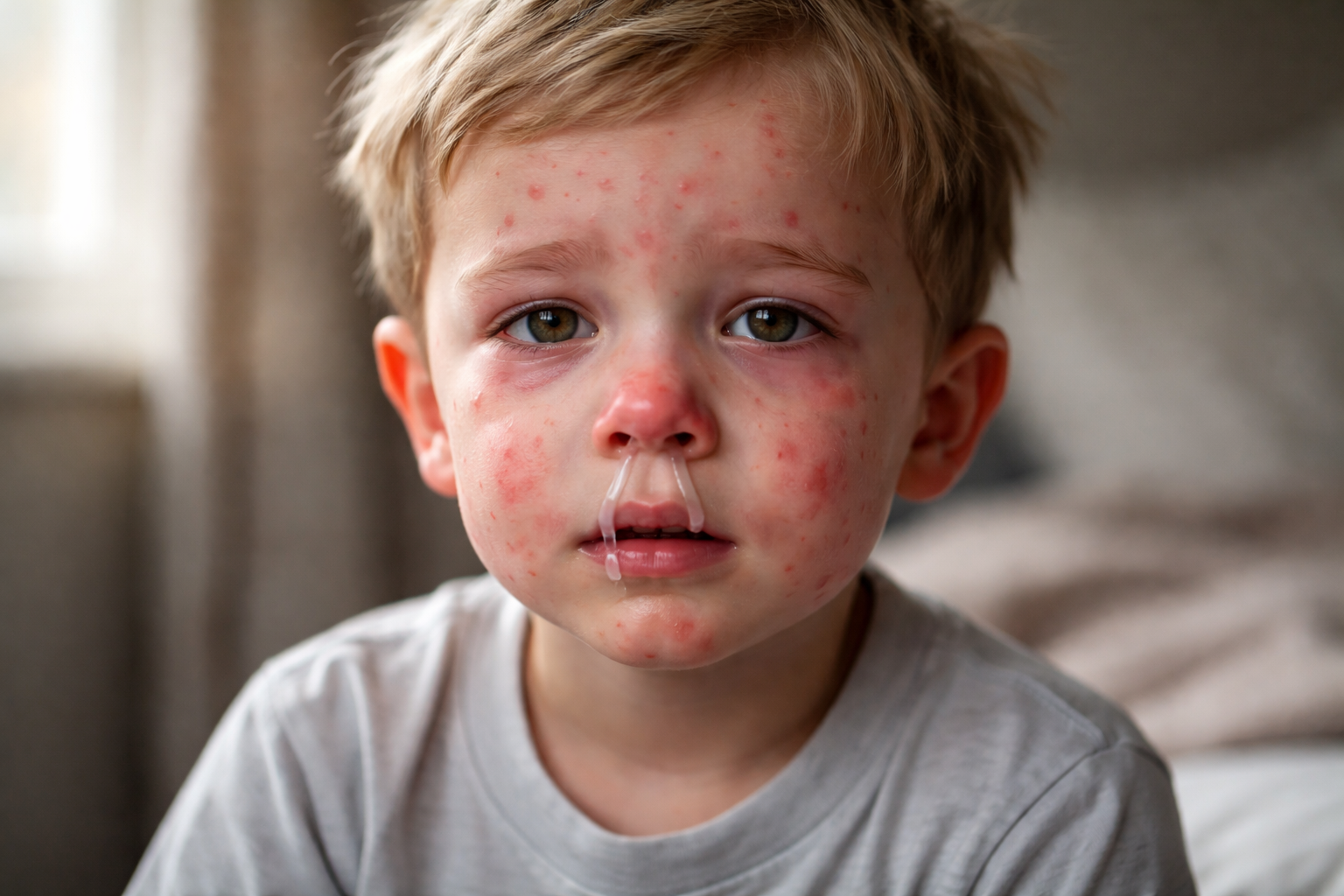
5. Sore Throat and General Discomfort – You may notice a sore throat, headache, or muscle aches as part of the initial phase pennmedicine.org. Penn Medicine lists sore throat and muscle pain among early measles symptoms (though these can also occur with other viruses), pennmedicine.org.
6. Koplik’s Spots – A telltale sign of measles is tiny white spots (like grains of salt) on the inner cheek or roof of the mouth, cdc.govpennmedicine.org. These “Koplik spots” often appear 2–3 days after early symptoms. If you or your doctor sees them, it’s a red flag for measles cdc.gov.
7. Measles Rash Appears – About 3–5 days after first symptoms, a red, blotchy rash breaks out cdc.govpennmedicine.org. It usually starts at the hairline or face. This maculopapular rash consists of flat red spots (sometimes with tiny bumps) that can merge together as they spread cdc.govpennmedicine.org.
8. Rash Spreading and Peaking – After the rash begins on the face, it spreads downward over 3–7 days to cover the torso, arms, legs, and sometimes even hands/feet cdc.govpennmedicine.org. At the same time, fever often spikes even higher, cdc.gov. The rash usually lasts about a week before fading, stanfordchildrens.orguniversityhealth.com.
9. Diarrhea – Upset stomach with severe diarrhea can occur, especially in young children, a few days after the rash starts stanfordchildrens.orgcdc.gov. It’s one of the more intense symptoms of measles that can cause, and should not be ignored.
10. Skin Peeling/Fading – As the rash fades (around 3–7 days after it started), the skin may peel and turn brownish before healing stanfordchildrens.org. While peeling isn’t an early sign per se, noticing rash fading and peeling confirms measles is moving into the late stage.
These ten signs – especially in combination – are strong clues that measles is present. Because they overlap with other illnesses, doctors often use Koplik spots and the distinctive rash to confirm measles, mayoclinic.orgstanfordchildrens.org. If you observe high fever plus
cough, red eyes, or rash, keep your child isolated immediately and call a doctor at cdc.govbaystatehealth.org.
Measles vs Other Illnesses: A Quick Comparison
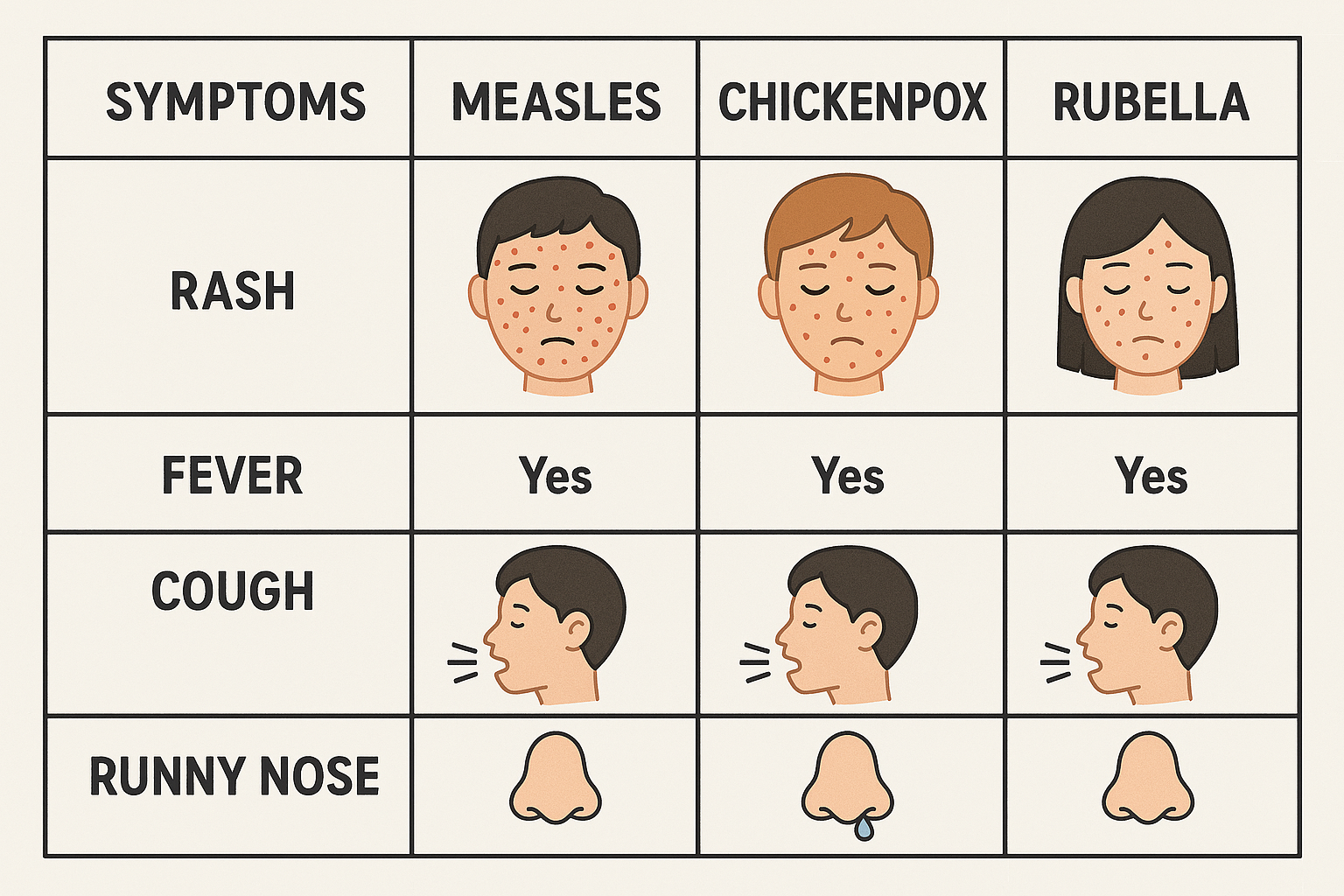
Sometimes measles symptoms can look like other childhood diseases (chickenpox, rubella, etc.). The table below highlights key differences in symptoms, rash appearance, and contagion. This helps identify measles versus lookalike rashes.
| Feature | Measles (Rubeola) | Chickenpox (Varicella) | Rubella (German Measles) |
|---|---|---|---|
Virus | Measles virus (Morbillivirus) |
Varicella-zoster virus |
Rubella virus (Togavirus) |
Contagiousness | Extremely high – ~90% of unvaccinated exposed get it pennmedicine.org; airborne (virus lingers 2hr |
High – spreads by
droplets/contact;
contagious 1–2 days
before rash until all
blisters crust cdc.gov. |
High – spreads
by droplets;
contagious ~7
days before to 7
days after rash
(often milder
spread). |
Incubation (exposed→symptoms) | ~10–14 days (may be 7–21)pennmedicine.org. | ~10–21 days (common~14) medicalnewstoday.com. | ~14–21 days (2–3 weeks) mayoclinic.org. |
Early Symptoms | Fever often >104°F cdc.gov, cough, runny nose, red eyes cdc.govcambridgepublichealth.org; Koplik spots in | Fever, headache, tiredness; then itchy rash (blister→crust) cdc.gov. | Low-grade fever, swollen glands, rash on face; joint pain common in adults |
This table shows measles’ hallmark symptoms (fever, cough, red eyes, Koplik’s spots, rash) compared to similar illnesses. If you see Koplik spots or a blotchy rash with high fever, it points strongly to measles cdc.govpennmedicine.org. When in doubt, see a doctor for a
proper diagnosis (rashes can look similar).
Symptoms in Adults vs. Children
The symptoms of measles are largely the same in adults and children – high fever, cough, runny nose, red eyes, and rash. However, measles can hit adults harder. In fact, recent reports note that adults born after 1963 should ensure they’ve had two MMR shots baystatehealth.orgcdc.gov. Adults often have the classic symptoms (sometimes more painfully), and nearly 100% of unvaccinated exposed adults get infected, universityhealth.compenmedicine.org.
A Baystate Health advisory (2025) emphasizes: “Measles is highly contagious – even more so than the flu or COVID – and adults can
get it too.” Their listed adult symptoms (fever, cough, congestion, runny nose, red eyes) match what doctors see in kids baystatehealth.org.
Some differences: Adults are more likely to suffer severe complications, and in rare cases, they may not develop the rash at all, making diagnosis tricky baystatehealth.org. But early symptoms like cough, fever, and red eyes should always raise suspicion. Remember:
Anyone (child or adult) exposed to measles can be contagious 4 days before their rash appears and for 4 days after. cdc.gov.
Why Measles is So Dangerous
If you get measles, take it seriously. Most people recover, but measles can be dangerous. Common complications include ear infections and diarrhea cdc.govpennmedicine.org. More severe ones are pneumonia (lung infection) and encephalitis (brain swelling), cdc.govpennmedicine.org. In fact, pneumonia is the leading cause of measles-related death in children, cdc.gov. About 1 in 1,000 measles patients develops encephalitis, which can leave permanent damage like deafness or intellectual disability, cdc.gov. Tragically, CDC data notes 1–3 deaths per 1,000 children with measles cdc.gov.
The very young, elderly, Pregnant women, and people with weak immune systems are at greatest risk cdc.govcambridgepublichealth.org.
Aside from acute illness, measles can have long-term effects. The rare but fatal condition, subacute sclerosing panencephalitis (SSPE), can strike years after measles infection cdc.govmerckmanuals.com. SSPE is a progressive brain disease that almost always leads
to death merckmanuals.com. Measles can also suppress the immune system for months (even years) after infection, leaving survivors more vulnerable to other infections.
On the plus side, most healthy people fully recover from measles with no lasting harm cambridgepublichealth.org. The body clears the virus, and symptoms resolve. But recovery can take weeks – high fever and rash can last 7–10 days, plus more days for full energy to
return. And “most fully recover” does not mean mild – the illness itself is rough, and serious complications can happen. Biggest Risks: In summary, the greatest dangers of measles are pneumonia and encephalitis, which can cause long-term disability or death cdc.govpennmedicine.org.
In rare cases, measles in pregnancy can cause miscarriage or preterm birth cdc.gov. The loss of immunity from measles (immune amnesia) also raises the risk of other infections afterward. That’s why public health messaging emphasizes the “danger of death and
permanent side effects” from measles, even though it was once thought of as just a childhood cold, cdc.govcambridgepublichealth.org.
How Long Does Measles Last?
From exposure to feeling better, measles is usually a 2–3 week illness. Here’s a rough timeline:
● Incubation (exposure to first symptoms): ~7–14 days (often 10 days). Some cases up to 21 days, pennmedicine.org. You are contagious during the last 4 days of incubation, even before symptoms.
● Prodromal (early symptoms): 2–4 days of high fever, cough, runny nose, red eyes. Koplik’s spots may appear in the mouth about 2–3 days in cdc.govpennmedicine.org.
● Rash phase: Around day 3–5 after first symptoms, rash breaks out on face and quickly spreads downward, cdc.govpennmedicine.org. The rash peaks at about 4–7 days after it starts and then begins to fade.
● Recovery: The rash fades in the same order it appeared (face to body) over about 3–5 more days, stanfordchildrens.orguniversityhealth.com. Full resolution of fever and symptoms usually happens in the second week of illness. Most people feel back to normal by 2–3 weeks after rash onset, though fatigue may linger.
If all goes well, measles runs its course in about 1–2 weeks after symptoms start. During
this time, you are contagious until ~4 days after the rash begins, cdc.gov. After that, the virus
is typically no longer spread to others, though immune recovery may take longer.
Diagnosing Measles
Because early measles mimics a bad cold or flu, doctors look for telltale signs to confirm it. Key identifiers: The raised fever, runny nose, cough, red eyes, and especially the rash pattern. The rash of measles (flat red spots starting at the face/hairline) is distinctive,
cdc.govpennmedicine.org. Finding Koplik’s spots inside the mouth clinches the diagnosis. A medical provider will also ask about vaccination history or travel (recent outbreaks in some countries), mayoclinic.org.
For a definitive check, they may do lab tests: a throat or nose swab, and blood or urine for measles antibodies, mayoclinic.org. Penn Medicine notes that doctors usually diagnose by exam (rash + Koplik) and confirm with lab testing if needed, mayoclinic.org. It’s important
to call ahead and isolate if you suspect measles, so clinics can take precautions.
Treating Measles
There is no specific cure or antiviral for measles. Treatment is entirely supportive and symptom-focused mayoclinic.orgcdc.gov. Key steps include:
● Rest and Fluids: Drink plenty of water, electrolyte solutions, or broths to prevent dehydration from fever and (if present) diarrhea mayoclinic.orgcdc.gov.
● Fever and Pain Relief: Use acetaminophen (Tylenol) or ibuprofen to reduce fever and relieve aches, mayoclinic.org. Do NOT give aspirin to children or teens (risk of Reye’s syndrome).
● Ease Cold Symptoms: Saline nose drops or humidifiers can help with congestion; Give children acetaminophen/ibuprofen as recommended for discomfort, mayoclinic.org.
● Vitamin A: The CDC recommends two doses of vitamin A for all children with acute measles (age-specific doses). cdc.gov. This is because vitamin A can reduce measles mortality and complications, especially in areas where children might be vitamin A-deficient, cdc.gov. It must be done under a doctor’s supervision (overdose risk).
● Treat Complications: If secondary infections occur, a doctor may prescribe antibiotics (for bacterial pneumonia or ear infection), mayoclinic.org. Severe airway Inflammation may require oxygen or steroids as judged by a physician, cdc.gov.
For children with measles, care is essentially the same, with extra attention to hydration and nutrition mayoclinic.org. If they have low vitamin A (or are underweight), the doctor often gives the vitamin A shots immediately mayoclinic.orgcdc.gov. If the child is very young (<6
months) or severely ill, doctors might consider antiviral ribavirin, mayoclinic.org. But mostly, it’s a “wait it out” illness under medical supervision. Importantly: Isolate the patient. Keep anyone with measles away from school or work until at least 4 days after the rash appeared, cdc.gov.
If exposed to others (especially infants or immunocompromised people), follow CDC guidance: vaccinate or give immunoglobulin as
prophylaxis. cdc.gov. In short: Treat measles with comfort care: fluids, fever reducers, vitamin A, and doctor-guided support. Most cases improve without complication. The focus is on preventing complications and breaking the chain of infection, rather than “curing” the virus directly.
Protecting Against Measles
The single best protection against measles is vaccination. The MMR (measles-mumps-rubella) vaccine is extremely safe and effective, cdc.gov. Two doses of MMR protect about 97% of people from measles, cdc.gov. For children, the routine schedule is first dose at 12–15 months and second at 4–6 years. If you or your child were born after 1957 and missed vaccination or are unsure, get vaccinated now – there’s no risk in re-vaccinating. baystatehealth.orgcdc.gov.
cdc.gov MMR vaccination is the best way to prevent measles and its complications. – CDC Fact Sheet Aside from vaccines, basic hygiene helps reduce spread: cover coughs, wash hands often, and avoid sharing utensils with infected people. In an outbreak or after exposure, health officials may recommend:
● MMR within 72 hours post-exposure – it can prevent or lessen measles cdc.gov.
● Immune globulin (IG) within 6 days for infants or immune-compromised – this can mitigate illness cdc.gov.
● Quarantine: Exposed, unvaccinated people often need to stay home for 4 days after the rash appears in the last case.
Travelers should be fully vaccinated before going abroad, cdc.gov. Pregnant women who are not immune should avoid outbreaks entirely (MMR can’t be given during pregnancy). In summary: “The best protection against measles is the MMR vaccine”cdc.gov. Community
immunity also protects vulnerable groups (infants too young for the vaccine, immunocompromised, pregnant women). Keeping vaccination rates high is the most effective defense, given how contagious measles is.
Conclusion and Next Steps
Measles might seem like a relic of the past, but it’s very much a present-day threat. If your child or someone you care about shows any of the early symptoms above – especially a high fever with cough and red eyes followed by a rash – take action immediately. Call your doctor, stay isolated, and follow their guidance at cdc.govbaystatehealth.org. Even healthy people can get very sick, so prevention (vaccination and early detection) is key.